

Roots and Wings
A First Convening

This past Friday, in the rolling hills of Southern Oregon, Bee Regenerative hosted the first Roots and Wings: Regenerative Viticulture Confluence — a small, place-based gathering of Southern Oregon winemakers committed to growing grapes in partnership with the land and the bees.
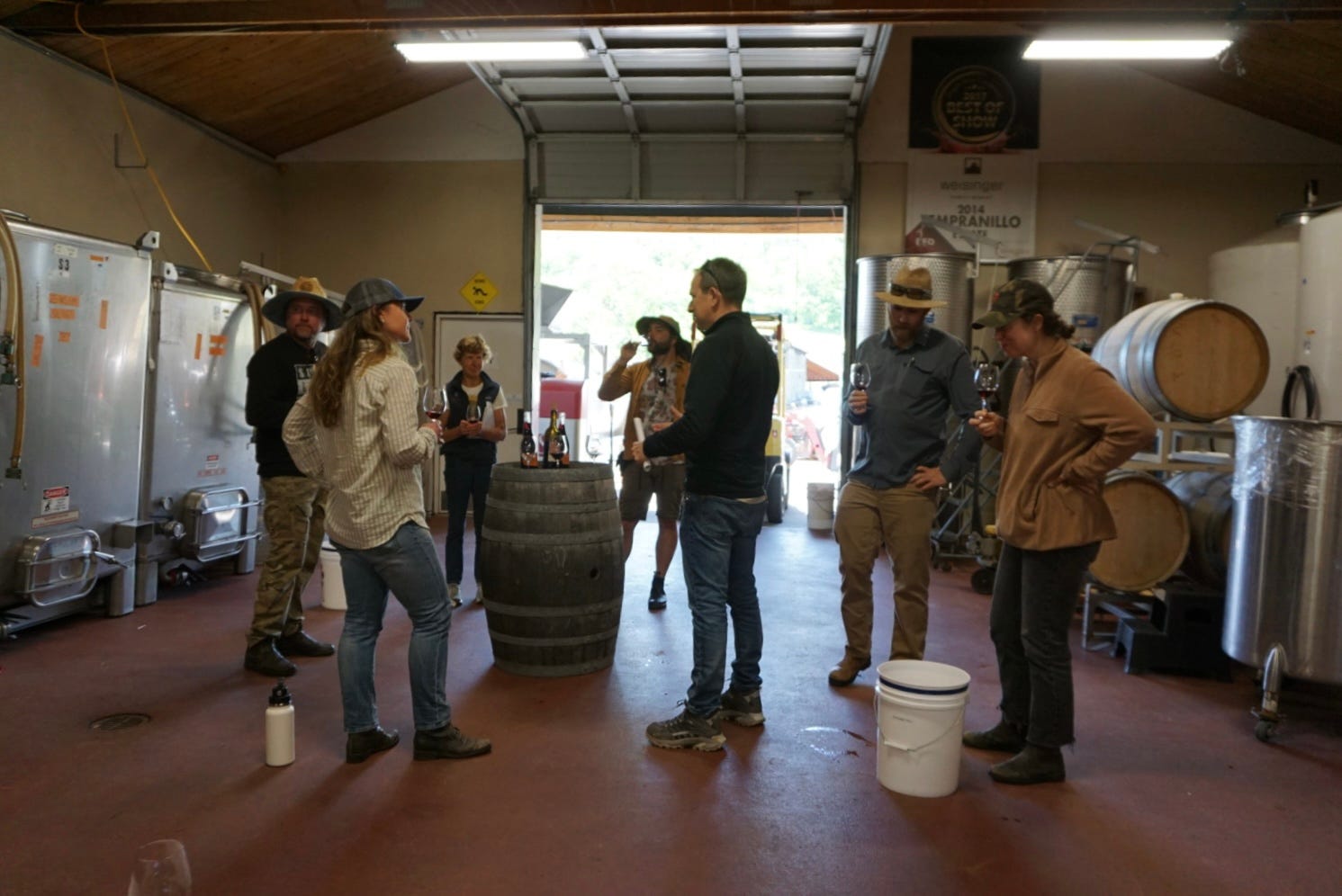
Five vineyards joined us: Cole Family Vineyards, Troon Vineyard, Weisinger’s Family Vineyard, Upper Five Vineyard, and Sound and Vision Wine Co. We were joined by Mimi Casteel of Hope Well Wine, who delivered a keynote on regenerative viticulture and soil health that set the tone for the day. We were nourished beautifully by a lunch by Jefferson Farm Kitchen. And our newest Bee Regenerative board member, Rhianna Sims, gave a blessing before the meal that I’ll be carrying with me for a long time — a naming of the farmers and hands behind the food we were about to share.
We spent the morning in conversation and the afternoon on the ground, walking three Southern Oregon vineyards and watching three different approaches to land stewardship play out in real time. The conversation that closed the day, around a small circle at Sound and Vision, gave me more material to think about than I can fit into a newsletter. But here is the headline: every single vineyard in the room committed to a concrete next step — a formal partnership, a new flowering trial, a habitat plan for an expanding vineyard, a planning session to build out the year. Five-for-five.
That is not a small thing. The wine industry is going through the hardest stretch most of us have ever seen. The demands on small vineyard operations are enormous, and the margins are tightening. And yet these growers, every one of them, said yes to doing more for bees, for biodiversity, for the long arc of the land. That is what hope looks like.
It is also, I think, what BFV’s next chapter looks like. The conversation revealed three through-lines I’m carrying forward: economics (broadly defined — kinship with land is also a kind of economic value), community (which Southern Oregon’s regenerative growers are hungry for and which BFV is positioned to host), and capacity (the design principle that the work we ask of growers has to add to their lives and operations, not subtract). I’ll be writing more about each of these as the year unfolds.
For now: huge thanks to our funders — The Bee Regenerative Donors, Autzen Foundation, One Hive Foundation, and Jackson Soil and Water Conservation District — for making the day possible. To our vineyard hosts. To the Selberg Institute for the kitchen and classroom. To Mimi. To Rhianna. To everyone who came. This is what refugia looks like, in early form: vineyards becoming places where bees come not to die, but to heal.
Roots and Wings 2027 is already taking shape. More soon.
— Sarah


